
How Vent Membranes Work: Waterproof Breathable Technology Explained
Learn how waterproof breathable vent membranes work through advanced ePTFE microporous technology. Ventrase vent membranes provide controlled airflow, pressure equalization, and protection against water, dust, and contaminants.
Contact Ventrase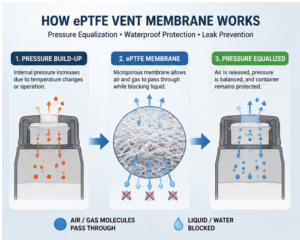
What Is a Vent Membrane?
A vent membrane is a specially engineered breathable material designed to allow air and vapor exchange while helping block water, liquids, dust, and contaminants.
Air Permeability
Vent membranes allow gases and air molecules to pass through, helping maintain airflow and prevent pressure imbalance.
Waterproof Protection
The microporous structure prevents liquid penetration while maintaining breathable performance.
Pressure Equalization
Vent membranes balance internal and external pressure caused by temperature changes, altitude variations, and operating conditions.
The Principle Behind Waterproof Breathable Vent Technology
Ventrase uses advanced expanded PTFE (ePTFE) membrane technology. The membrane contains millions of microscopic pores that are designed to allow air exchange while blocking water droplets and external contaminants.
Vent Membrane Function
Air & Vapor
↓
ePTFE Microporous Membrane
↓
Water / Dust Protection
How Does a Vent Membrane Work?
A waterproof breathable vent membrane controls the movement of gases while creating a protective barrier against liquids and contaminants. This allows packaging and equipment to maintain stable pressure without compromising protection.
Pressure Change
Temperature, altitude, or chemical reactions may create pressure differences inside sealed products.
Air Movement
Gas molecules move through the microporous membrane to balance internal and external pressure.
Liquid Blocking
Water droplets and liquids are blocked by the waterproof membrane structure.
Pressure Balance
The system maintains stable pressure while protecting internal components.
Vent Membrane Working Principle
Internal Pressure
Air Expansion
Temperature Change
ePTFE Membrane
Microporous Structure
Stable System
Pressure Balance
Protection
ePTFE Microporous Membrane Structure
Expanded PTFE (ePTFE) membranes contain a network of microscopic pores. These pores are engineered to provide high airflow performance while maintaining waterproof protection.
- Allows air and vapor transmission
- Blocks water droplets and liquids
- Reduces dust and particle penetration
- Provides chemical resistance
Microporous ePTFE Layer
Gas molecules can pass through the membrane structure while larger liquid droplets and contaminants are blocked.
Water Droplets ✕
Dust Particles ✕
Why Choose ePTFE Vent Membrane Technology?
High Airflow Performance
Provides efficient gas exchange for pressure management in demanding applications.
Excellent Waterproof Capability
Helps protect products and equipment from water ingress and liquid exposure.
Chemical Resistance
Suitable for packaging, electronics, automotive, and industrial environments requiring durable protection.
Applications of Vent Membrane Technology
Waterproof breathable vent membranes are widely used in packaging, electronics, automotive, batteries, and industrial equipment to manage pressure while protecting sensitive components.
Packaging Vent Applications
Vent membranes help bottles, containers, and industrial packaging maintain pressure balance while reducing risks of swelling, collapse, leakage, and deformation.
Explore Packaging Solutions →Electronics Protection
Electronic housings require pressure equalization to reduce stress on seals and prevent condensation caused by temperature changes.
Explore Electronics Solutions →Battery Vent Applications
Battery systems use vent membranes to manage gas pressure while helping protect internal components from moisture and contaminants.
Explore Applications →Why Industries Use Waterproof Breathable Vent Membranes
Sealed products often experience pressure changes during transportation, storage, or operation. Without proper ventilation, pressure differences may cause packaging deformation, seal damage, or product failure.
Ventrase vent membrane solutions provide a controlled pathway for air exchange while maintaining waterproof and contamination protection.
Common Problems Solved
- Container swelling caused by pressure buildup
- Housing deformation caused by vacuum pressure
- Condensation inside sealed equipment
- Moisture and dust exposure
- Transportation pressure changes
Vent Membrane Material Comparison
Different membrane materials provide different levels of airflow, waterproof performance, and chemical resistance. ePTFE is widely selected for demanding applications requiring long-term reliability.
| Material | Airflow | Waterproof | Chemical Resistance | Typical Applications |
|---|---|---|---|---|
| ePTFE | ★★★★★ | ★★★★★ | ★★★★★ | Electronics, Packaging, Industrial |
| PE | ★★★★ | ★★★★ | ★★★ | General Packaging |
| PP | ★★★★ | ★★★★ | ★★★★ | Chemical Packaging |
Explore Ventrase Vent Technology
ePTFE Membrane
Learn more about expanded PTFE waterproof breathable membrane technology.
Learn More →Vent Plugs
Discover press-fit and waterproof vent plug solutions for industrial packaging.
View Products →Vent Liners
Explore breathable sealing liners for bottle caps and packaging applications.
Explore Solutions →Need Pressure Equalization Solutions?
Ventrase provides customized waterproof breathable vent solutions for packaging, electronics, batteries, and industrial applications. Our engineering team can help select the right membrane structure, airflow performance, and venting solution.
Related Ventrase Solutions
Explore Ventrase waterproof breathable vent solutions designed for pressure equalization, packaging protection, and industrial applications.
ePTFE Vent Membrane
High-performance waterproof breathable membrane technology designed for pressure equalization, moisture protection, and demanding industrial applications.
Learn More →Press Fit Vent Plug
Ready-to-install waterproof vent plugs designed for packaging containers requiring pressure balance, gas release, and leakage protection.
View Products →Vent Liners
Breathable sealing solutions for bottles, chemical containers, lubricant packaging, and industrial packaging applications.
Explore Liners →Vent Packaging Solutions
Complete venting solutions for agrochemical, chemical, lubricant, and industrial packaging applications requiring reliable pressure control.
View Packaging Solutions →