
ePTFE Membrane vs. PTFE: Key Differences for Industrial Venting
PTFE and ePTFE are widely used materials in industrial applications that require chemical resistance, thermal stability, and reliable performance. Although they share the same base polymer, their structures and functional characteristics can differ significantly.
For engineers designing waterproof breathable systems, pressure equalization vents, or industrial filtration products, understanding the difference between PTFE and ePTFE is an important step in material selection.
This guide explains how these materials differ in structure, airflow, liquid resistance, manufacturing, and industrial applications.
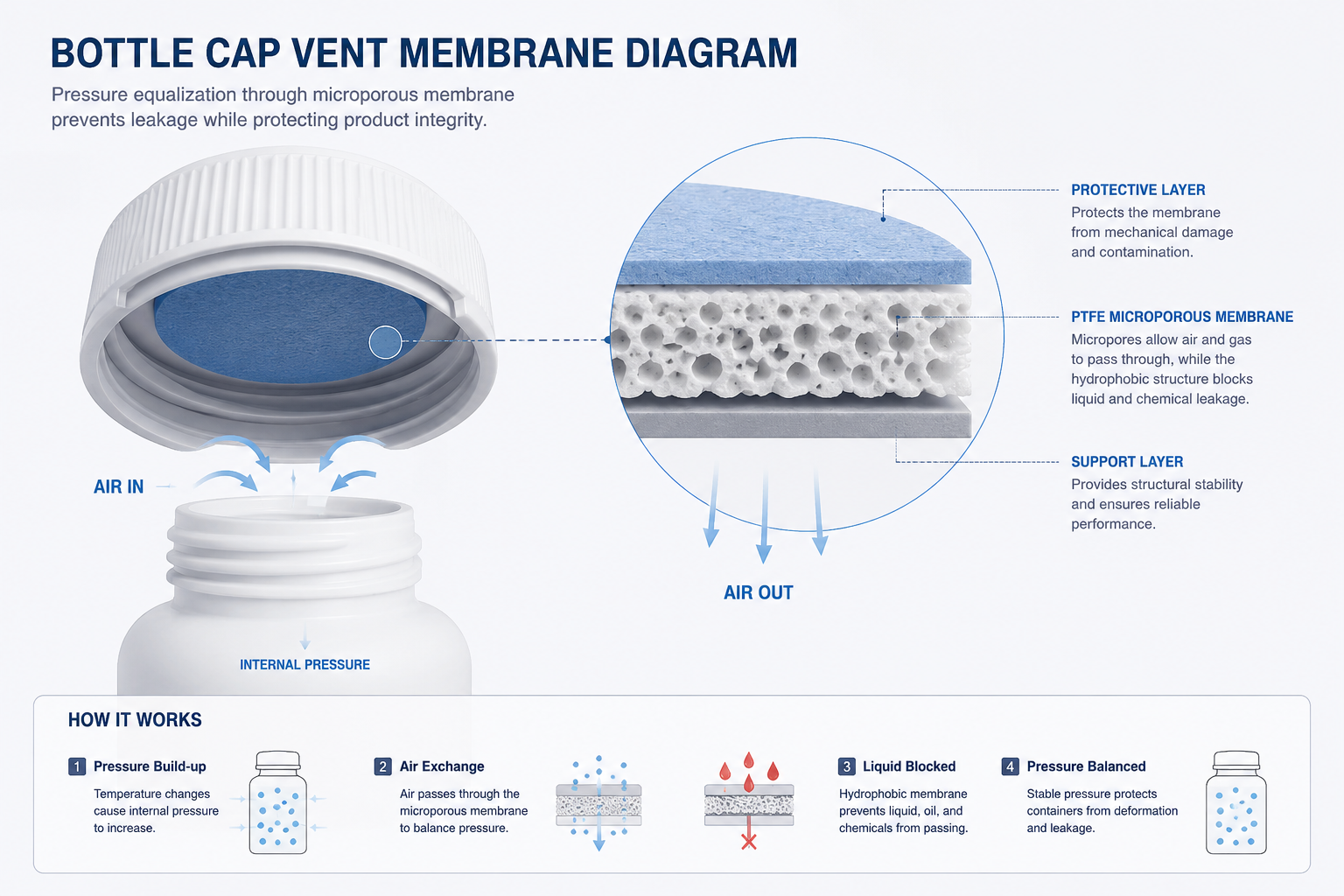
1. What Is PTFE?
PTFE stands for polytetrafluoroethylene, a fluoropolymer known for its chemical resistance, low friction, and thermal stability.
Its molecular structure provides excellent resistance to many aggressive chemicals and makes it useful in demanding industrial environments.
PTFE is used in a wide range of products, including:
- Sealing components and gaskets
- Chemical-resistant tubing
- Non-stick and low-friction surfaces
- Industrial filtration materials
- Protective coatings and electrical insulation
PTFE can also be manufactured into porous membranes through different processing methods. Therefore, PTFE should not automatically be understood as a completely solid or nonporous material.
The actual performance of a PTFE membrane depends on its manufacturing process, pore structure, thickness, surface treatment, and final construction.
2. What Is ePTFE?
ePTFE stands for expanded polytetrafluoroethylene. It is produced by expanding PTFE under controlled processing conditions to create a microporous structure.
The resulting membrane contains a network of interconnected pores. This structure can allow air and water vapor to pass through while resisting the penetration of liquid water, depending on the membrane design and operating conditions.
The expanded structure also provides a combination of flexibility, porosity, and mechanical properties that can be useful in industrial venting applications.
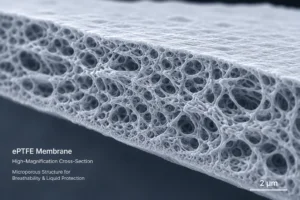
Learn more about the material structure and operating principles in our ePTFE membrane technology guide .
3. Key Differences Between PTFE and ePTFE
The main difference is not the chemical composition, but the physical structure and the way the material is engineered for a specific function.
| Property | PTFE | ePTFE |
|---|---|---|
| Full name | Polytetrafluoroethylene | Expanded polytetrafluoroethylene |
| Base polymer | PTFE | PTFE |
| Structure | Can be solid, porous, or membrane-based | Expanded microporous structure |
| Air permeability | Depends on the specific construction | Can be engineered for controlled airflow |
| Water resistance | Depends on structure and surface properties | Can provide liquid water resistance through controlled pores |
| Venting suitability | Suitable for some porous membrane designs | Commonly used in pressure equalization and breathable venting |
| Mechanical properties | Depend on processing and construction | Depend on expansion ratio, orientation, thickness, and support layers |
| Typical applications | Seals, gaskets, coatings, tubing, filtration | Protective vents, breathable membranes, specialized filtration |
This comparison describes general material characteristics. Actual performance must be verified using the technical data and test results of the specific membrane grade.
3.1 Structure and Porosity
Conventional PTFE products may be designed for sealing, insulation, or chemical protection, where air permeability is not required.
ePTFE is expanded to create a porous network. The pore structure can be adjusted during manufacturing to achieve different combinations of airflow, liquid resistance, and mechanical performance.
3.2 Airflow and Pressure Equalization
In a sealed enclosure, temperature changes can cause internal pressure to increase or decrease relative to the surrounding environment.
A suitable ePTFE vent membrane allows air to move through the membrane, helping reduce pressure differences across enclosure seals.
The required airflow depends on enclosure volume, temperature variation, pressure limits, and the expected operating environment. A membrane should therefore be selected according to the required airflow at a defined pressure differential, rather than by material name alone.
For more information, read our guide to pressure equalization and industrial venting .
3.3 Waterproof and Breathable Performance
The microporous structure of hydrophobic ePTFE membranes can allow air and water vapor to pass while resisting liquid water penetration.
However, waterproof performance is not determined by the material name alone. It also depends on pore characteristics, membrane construction, surface properties, pressure exposure, and the integrity of the finished vent assembly.
For applications involving oils, surfactants, or other low-surface-tension liquids, additional oleophobic treatment or a different membrane construction may be required.
4. Why ePTFE Is Used in Industrial Venting
Industrial venting applications often require a combination of properties that are difficult to achieve with a conventional solid film.
A properly designed ePTFE membrane can provide several functional benefits:
- Pressure equalization: Allows air exchange to reduce pressure differences.
- Liquid water resistance: Helps protect sensitive components from water ingress.
- Contaminant protection: Can help restrict dust and particulate intrusion.
- Chemical resistance: PTFE-based materials offer broad chemical resistance, subject to specific exposure conditions.
- Thermal stability: PTFE has a wide useful temperature range, but finished membrane limits must be verified.
For industrial enclosure applications, the membrane is often combined with adhesive layers, support materials, or a protective housing to create a complete venting solution.
5. Common Applications of ePTFE Membranes
5.1 Electronic Enclosures
Outdoor electronics may experience rapid temperature changes, humidity, rain, and pressure fluctuations. ePTFE vents can help balance internal and external pressure while providing a barrier against liquid water.
5.2 Battery Enclosures
Battery systems require carefully engineered venting and environmental protection. ePTFE membrane materials may be used in enclosure venting systems, depending on the system’s pressure, temperature, chemical, and safety requirements.
5.3 Chemical Packaging
Certain chemical containers can develop pressure differences during filling, storage, transportation, or temperature changes.
A suitable venting solution can help reduce container deformation while maintaining liquid containment. The membrane must be evaluated against the actual chemical formulation and exposure conditions.
5.4 Automotive Components
Automotive lighting, sensors, and electrical housings can benefit from pressure equalization and moisture management.
The correct membrane design depends on the required airflow, environmental exposure, mechanical durability, and assembly method.
6. How to Select the Right Material
Choosing between PTFE and ePTFE requires a clear understanding of the final application.
Before selecting a membrane, engineers should evaluate the following parameters:
| Selection Parameter | What to Evaluate |
|---|---|
| Required airflow | Airflow at a specified pressure differential |
| Water entry pressure | Required resistance to liquid water penetration |
| Chemical exposure | Liquid type, concentration, temperature, and duration |
| Operating temperature | Minimum and maximum service temperatures |
| Mechanical requirements | Flexibility, puncture resistance, support, and handling |
| Assembly method | Adhesive bonding, lamination, welding, or mechanical installation |
| Validation requirements | Airflow, water entry pressure, environmental, and durability testing |
For customized industrial venting projects, the required specifications should be reviewed before finalizing the membrane grade and assembly design.
Looking for a Custom ePTFE Venting Solution?
Ventrase provides ePTFE vent plugs and venting materials for industrial packaging, electronic enclosures, and other pressure equalization applications.
Explore our ePTFE venting products and engineering solutions to discuss your application requirements.
7. Frequently Asked Questions
Is ePTFE the same material as PTFE?
Yes. ePTFE is expanded polytetrafluoroethylene. It shares the same base polymer as PTFE but has a microporous structure created through expansion.
Is ePTFE always more breathable than PTFE?
No. Breathability depends on the specific membrane structure and manufacturing process. Some conventional PTFE membranes are also porous and breathable.
Can ePTFE membranes block liquid water while allowing air to pass?
Yes, appropriately designed hydrophobic ePTFE membranes can provide this combination of properties. Actual performance depends on pore structure, water entry pressure, and operating conditions.
Is ePTFE suitable for chemical packaging?
It can be suitable for many chemical packaging applications, but compatibility must be verified against the actual chemical formulation, concentration, temperature, and exposure duration.
How do I choose an ePTFE membrane for industrial venting?
Start with the required airflow, water entry pressure, chemical compatibility, temperature range, and assembly requirements. Then validate the selected membrane using application-specific testing.
Conclusion
PTFE and ePTFE share the same chemical foundation, but their physical structures can lead to different functional capabilities.
For applications requiring pressure equalization, controlled airflow, and resistance to liquid water, ePTFE membranes are commonly considered because of their microporous structure.
The best material is ultimately the one that meets the application’s performance requirements and has been validated under the intended operating conditions.
Explore more technical resources in the Ventrase ePTFE Knowledge Center .