
What Determines the Pore Size of an ePTFE Membrane?
Pore size is one of the most important characteristics of an expanded polytetrafluoroethylene (ePTFE) membrane. It influences how air, gases, and liquids move through the membrane and plays an important role in determining its performance in industrial venting applications.
However, ePTFE membrane pore size is not controlled by a single manufacturing parameter. It depends on the combined effects of material properties, stretching conditions, membrane structure, and subsequent processing.
For engineers selecting an ePTFE vent membrane, understanding these relationships helps balance airflow, waterproof performance, and mechanical reliability.
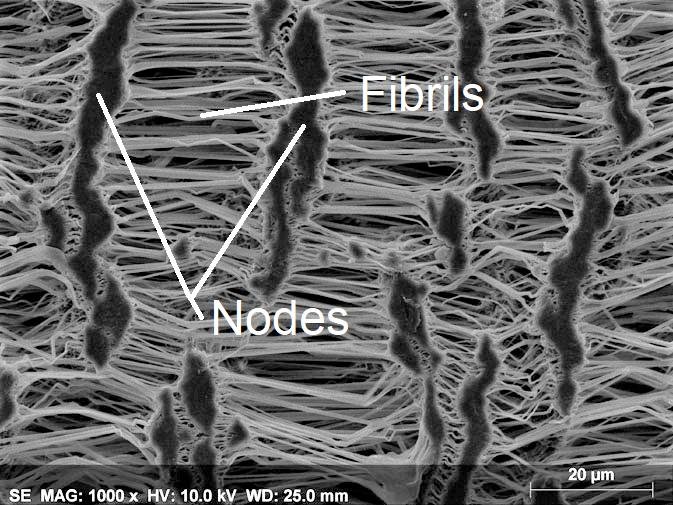
1. Understanding ePTFE Membrane Pore Structure
ePTFE membranes are produced by expanding PTFE under controlled conditions. This process creates a microporous structure consisting of interconnected nodes and fibrils.
The spaces between these structural elements form pathways through which gases and, under suitable conditions, water vapor can pass.
Unlike a membrane with perfectly uniform cylindrical pores, ePTFE typically contains a complex network of interconnected openings with a distribution of pore sizes.
Therefore, a membrane is not usually described accurately by a single pore diameter alone.
Different pore-size measurements may describe:
- The largest effective pore
- The mean flow pore size
- A nominal pore-size rating
- The overall pore-size distribution
For a broader introduction to the material, see our ePTFE membrane technology guide .
2. How Manufacturing Determines Pore Size
The pore structure of ePTFE is developed during manufacturing, particularly during the stretching process.
Several manufacturing parameters influence the resulting pore structure.
2.1 Stretching Ratio
Stretching ratio describes the extent to which the PTFE material is expanded relative to its original dimensions.
The stretching process separates parts of the polymer structure and develops the interconnected microporous network.
Changes in stretching ratio can influence:
- Porosity
- Pore-size distribution
- Fibril dimensions
- Mechanical strength
- Air permeability
The relationship is not necessarily linear. The final pore structure depends on the resin grade, initial material structure, stretching direction, temperature, and the complete manufacturing process.
2.2 Stretching Temperature
Temperature influences the deformation behavior of PTFE during expansion.
The appropriate temperature range depends on the material formulation and processing method. It can affect fibril development, structural uniformity, and the stability of the expanded membrane.
For this reason, temperature must be controlled together with stretching ratio and stretching speed.
2.3 Stretching Direction
ePTFE membranes may be stretched in one direction or in two directions.
Uniaxial stretching can create directional structural properties, while biaxial stretching develops the membrane structure in both the machine direction and transverse direction.
The stretching method influences pore geometry, mechanical behavior, and the consistency of the finished membrane.
2.4 Resin and Initial Material Structure
The PTFE resin grade and the quality of the initial extruded or calendered material also influence the pore structure developed during expansion.
Variations in material consistency can lead to differences in stretching behavior and final membrane properties.

Learn more about the complete process in our ePTFE membrane manufacturing guide .
3. Pore Size vs. Porosity: What Is the Difference?
Pore size and porosity are closely related, but they describe different aspects of membrane structure.
Pore size describes the dimensions of the openings within the membrane.
Porosity describes the fraction of the membrane’s total volume occupied by void spaces.
A membrane can have relatively small pores while maintaining high porosity if it contains a large number of interconnected openings.
| Property | What It Describes | Why It Matters |
|---|---|---|
| Pore size | Dimensions of individual openings | Influences liquid entry and flow pathways |
| Porosity | Fraction of void volume | Influences available flow space |
| Pore-size distribution | Range of pore dimensions | Helps characterize membrane uniformity |
| Tortuosity | Complexity of flow pathways | Influences resistance to flow |
| Membrane thickness | Distance through the membrane | Influences flow resistance and structural properties |
These parameters work together to determine the membrane’s overall permeability.
4. How Pore Size Affects Airflow
Airflow describes the volume of air passing through a membrane under a defined pressure differential and test condition.
Larger effective flow pathways generally reduce resistance to gas flow. However, airflow also depends on porosity, membrane thickness, pore distribution, and the complexity of the internal structure.
This means that two membranes with similar nominal pore sizes may have different airflow performance.
Why Airflow Must Be Measured Under Defined Conditions
Air permeability results depend on the pressure differential applied across the membrane, the test area, and the measurement method.
When comparing technical data sheets, engineers should check:
- Airflow units
- Pressure differential
- Test temperature
- Effective test area
- Membrane thickness
- Test method and sample condition
For industrial venting, the objective is not necessarily to maximize airflow. The membrane must provide sufficient airflow to meet the system’s pressure equalization requirements while maintaining the required liquid protection.
5. How Pore Size Affects Waterproof Performance
Hydrophobic ePTFE membranes can resist liquid water penetration because water must overcome the capillary resistance of the membrane’s pores before entering the structure.
For a hydrophobic membrane, the pressure required for liquid entry is influenced by the effective pore opening, liquid surface tension, and the contact angle between the liquid and the membrane surface.
Under otherwise comparable conditions, smaller effective pore openings generally provide higher water entry pressure.
However, pore size is only one factor affecting waterproof performance.
Other important factors include:
- Surface treatment and hydrophobicity
- Liquid surface tension
- Pore-size distribution
- Membrane thickness and structure
- Mechanical damage or defects
- Finished assembly integrity
A membrane that performs well with clean water may behave differently when exposed to liquids containing surfactants, oils, or other low-surface-tension components.
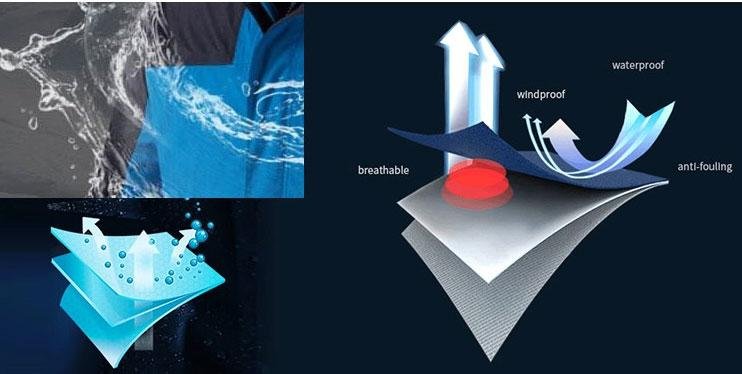
For additional information, see our waterproof breathable membrane engineering resources .
6. How Is ePTFE Membrane Pore Size Measured?
Pore size can be characterized using several methods. The appropriate method depends on the membrane structure and intended application.
6.1 Bubble Point Test
The bubble point test is commonly used to characterize the largest effective pore in a porous membrane.
The membrane is first wetted with a suitable test liquid. Gas pressure is then gradually increased until the first continuous gas flow is detected through the wetted membrane.
The pressure at this point is related to the size of the largest effective pore.
The relationship depends on the surface tension of the test liquid, the contact angle, and the membrane’s pore geometry.
6.2 Mean Flow Pore Size
Mean flow pore size provides a characteristic value derived from the relationship between gas flow through a dry membrane and a wetted membrane.
It helps describe the effective flow pathways within the membrane and is useful when comparing membrane structures.
6.3 Pore-Size Distribution
A pore-size distribution provides more information than a single nominal value.
It can help engineers understand whether a membrane contains a relatively narrow range of pore sizes or a broader distribution of openings.
| Measurement | What It Indicates |
|---|---|
| Bubble point | Largest effective pore |
| Mean flow pore size | Characteristic effective flow pathway |
| Pore-size distribution | Variation in pore dimensions |
| Air permeability | Gas flow performance under defined conditions |
| Water entry pressure | Resistance to liquid water penetration |
For pore-size characterization, ASTM F316 is a commonly referenced method for membrane bubble point and mean flow pore testing. The specific test procedure and test liquid should be confirmed for the membrane being evaluated.
7. How to Select the Right ePTFE Membrane Pore Structure
The correct membrane structure depends on the requirements of the finished product.
For industrial venting applications, engineers should evaluate the complete set of performance requirements rather than selecting a membrane based only on nominal pore size.
| Application Requirement | What to Evaluate |
|---|---|
| Pressure equalization | Required airflow at a specified pressure differential |
| Waterproof protection | Minimum water entry pressure |
| Chemical packaging | Compatibility with the actual chemical formulation |
| Outdoor electronics | Airflow, water resistance, dust protection, and environmental exposure |
| Mechanical reliability | Thickness, tensile strength, support structure, and assembly method |
| Product validation | Application-specific testing and finished assembly performance |
Need Help Selecting an ePTFE Venting Solution?
Ventrase provides ePTFE vent plugs and venting materials for industrial packaging, electronic enclosures, and pressure equalization applications.
Explore our ePTFE venting products and engineering solutions to discuss your application requirements.
8. Frequently Asked Questions
What is the typical pore size of an ePTFE membrane?
There is no single typical pore size for all ePTFE membranes. The pore structure varies depending on the manufacturing process and the intended application. Always refer to the specific membrane’s technical data.
Does a smaller ePTFE pore size always mean better waterproof performance?
Smaller effective pore openings generally increase water entry pressure under comparable conditions. However, surface properties, liquid surface tension, and membrane defects also influence waterproof performance.
Does a larger pore size always provide higher airflow?
Not necessarily. Airflow also depends on porosity, thickness, tortuosity, and the overall membrane structure. The actual airflow should be measured under defined conditions.
Can two ePTFE membranes have the same pore size but different airflow?
Yes. Differences in porosity, thickness, pore distribution, and internal structure can result in different airflow performance even when the nominal pore-size ratings are similar.
How can I compare ePTFE membrane pore size between suppliers?
Compare the measurement method, test liquid, bubble point or mean flow pore size, airflow, water entry pressure, and membrane thickness. Make sure the data are based on comparable test conditions.
Conclusion
The pore size of an ePTFE membrane is determined by a combination of material properties, manufacturing conditions, and the resulting microporous structure.
Stretching ratio, temperature, resin characteristics, porosity, and membrane thickness all contribute to the final performance.
For industrial venting, the most effective membrane is not necessarily the one with the smallest pores or the highest airflow. It is the membrane that provides the right balance of gas permeability, liquid protection, and mechanical reliability for the intended application.
Continue exploring the Ventrase ePTFE Knowledge Center for more technical information about membrane structure, manufacturing, and performance.