
How Is ePTFE Membrane Manufactured? A Step-by-Step Guide
Expanded polytetrafluoroethylene (ePTFE) membrane is widely used in industrial venting, filtration, protective materials, and waterproof breathable applications.
Although ePTFE is made from the same base polymer as conventional PTFE, its unique microporous structure is created through a specialized manufacturing process. The process determines important characteristics such as pore structure, air permeability, mechanical strength, and dimensional stability.
Understanding how ePTFE membrane is manufactured helps engineers evaluate material specifications and select the right membrane for demanding applications.
1. Overview of the ePTFE Manufacturing Process
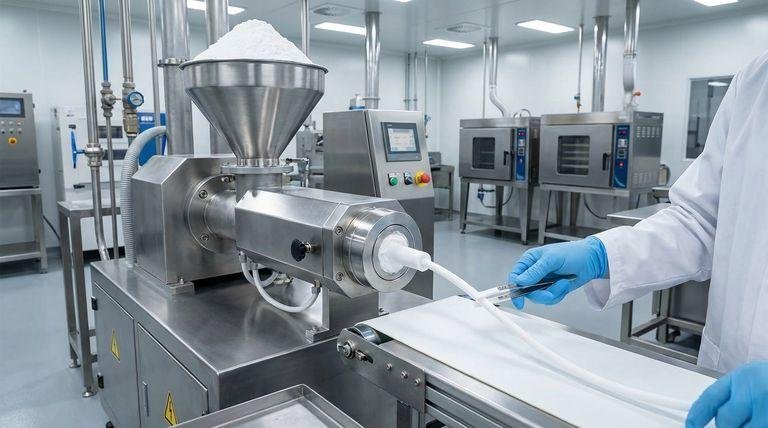
A common industrial method for producing ePTFE membranes uses fine PTFE resin powder, paste extrusion, calendering, controlled stretching, and heat setting.
The general manufacturing sequence is:
The exact process may vary depending on whether the final product is a flat membrane, tubular membrane, tape, filtration material, or specialized industrial venting component.
2. Step 1: PTFE Resin Selection
The manufacturing process begins with selecting a suitable PTFE resin.
Fine powder PTFE resin is commonly used in paste extrusion processes for producing expanded membranes. The resin grade can influence extrusion behavior, fibril development, and the mechanical properties of the finished material.
Important considerations include:
- Resin particle characteristics
- Material consistency between batches
- Processing behavior during extrusion
- Required mechanical properties
- Target membrane performance
Material selection is important because the resin must be capable of forming a uniform preform and developing the required structure during subsequent stretching.
3. Step 2: Mixing and Preforming
PTFE fine powder is mixed with a suitable processing lubricant to create a uniform paste.
The lubricant helps the material flow during extrusion and reduces the processing difficulties associated with PTFE’s limited melt processability.
After mixing, the paste is typically preformed under controlled pressure to create a compact billet.
Why Is Mixing Important?
Inconsistent mixing can create variations in material density and processing behavior. These variations may affect extrusion stability and the uniformity of the final membrane.
The main objectives of this stage are:
- Achieve uniform lubricant distribution
- Reduce air pockets in the preform
- Maintain consistent material density
- Prepare the material for stable extrusion
4. Step 3: Paste Extrusion
The preformed PTFE paste is forced through an extrusion die to produce a rod, sheet, or other intermediate shape.
During extrusion, the material experiences mechanical forces that influence its internal structure and processing behavior.
Extrusion conditions can affect:
- Material density and uniformity
- Extrudate dimensions
- Initial orientation of the PTFE structure
- Subsequent stretching performance
A consistent extrudate provides a more stable foundation for the following calendering and stretching processes.
5. Step 4: Calendering
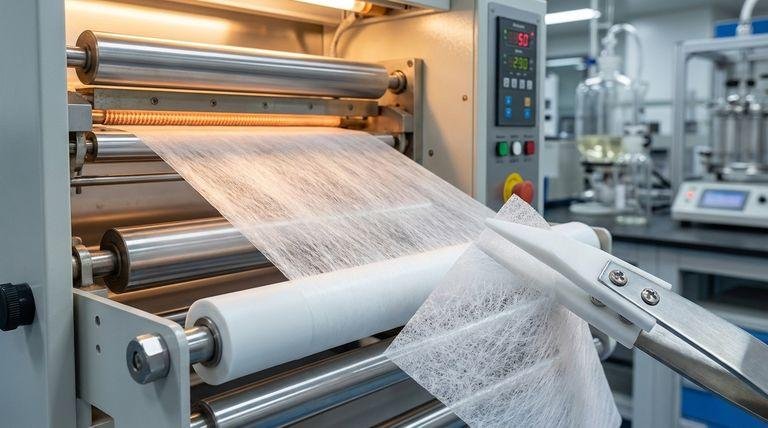
The extruded PTFE material is passed through rollers to form a thinner sheet or tape with controlled dimensions.
Calendering helps establish the initial thickness and orientation of the material before expansion.
Important process considerations include:
- Roller temperature
- Roller speed and gap
- Material thickness
- Surface quality
- Dimensional consistency
The resulting sheet becomes the starting material for the stretching process that creates the microporous structure.
6. Step 5: Stretching and Micropore Formation
Stretching is one of the most important stages in ePTFE membrane manufacturing.
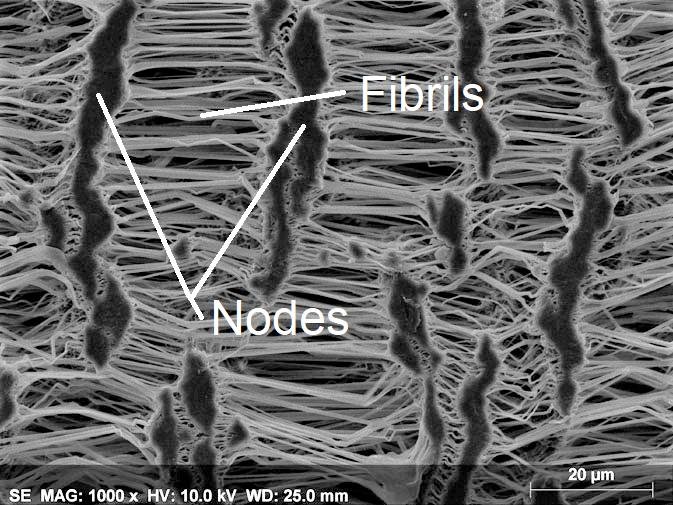
The PTFE sheet is stretched under controlled conditions. This process separates parts of the polymer structure and develops a network of interconnected pores.
The resulting structure is commonly described as a node-and-fibril network.
6.1 Uniaxial Stretching
Uniaxial stretching expands the material primarily in one direction.
This approach can create directional properties, which may be useful for certain membrane and tape applications.
6.2 Biaxial Stretching
Biaxial stretching expands the material in two directions, typically the machine direction and transverse direction.
The relationship between these stretching directions influences the final membrane structure and mechanical behavior.
6.3 How Stretching Affects Membrane Properties
Stretching conditions influence the structure and performance of the finished membrane.
| Process Parameter | Potential Effect |
|---|---|
| Stretch ratio | Influences expansion, porosity, and structural development |
| Stretching temperature | Affects material deformation and fibril formation |
| Stretching speed | Influences deformation behavior and process stability |
| Stretching direction | Influences directional mechanical properties |
| Initial sheet thickness | Influences final membrane dimensions and consistency |
These relationships are process-dependent. The final membrane properties must be verified through testing rather than predicted from a single manufacturing parameter.
7. Step 6: Heat Setting and Structure Stabilization
After stretching, the membrane undergoes controlled heat treatment to stabilize its structure.
Heat setting helps reduce unwanted dimensional changes and maintain the structure developed during stretching.
The process must be carefully controlled because excessive or insufficient thermal treatment can affect the final material properties.
Important considerations include:
- Temperature profile
- Residence time
- Stretching tension during heat treatment
- Cooling conditions
- Dimensional stability
8. Step 7: Finishing and Quality Testing
After heat setting and cooling, the membrane may undergo additional finishing operations depending on its intended application.
These may include:
- Slitting and cutting
- Lamination with support materials
- Surface treatment
- Adhesive coating
- Conversion into finished venting components
Quality Control During Production
Quality testing is essential to verify that the membrane meets its intended specifications.
| Test | Purpose |
|---|---|
| Thickness measurement | Verify dimensional consistency |
| Air permeability | Evaluate airflow under specified conditions |
| Water entry pressure | Evaluate resistance to liquid water penetration |
| Tensile testing | Evaluate mechanical strength |
| Porosity or pore characterization | Assess membrane structure |
| Dimensional stability | Evaluate changes after thermal or environmental exposure |
For industrial venting applications, testing should reflect the actual requirements of the finished product rather than relying only on raw membrane specifications.
Learn more about membrane performance evaluation in our ePTFE membrane testing and engineering resources .
9. Key Manufacturing Parameters That Affect Membrane Performance
The performance of an ePTFE membrane is determined by the combined effect of material selection, process conditions, and quality control.
The following parameters are particularly important:
- Resin grade: Influences processing behavior and structural development.
- Lubricant distribution: Affects paste consistency and extrusion stability.
- Extrusion conditions: Influence material density and initial structure.
- Calendering conditions: Determine initial thickness and orientation.
- Stretching conditions: Influence pore formation and membrane properties.
- Heat setting: Helps stabilize the expanded structure.
- Finishing process: Can influence the performance of the finished membrane assembly.
For engineers selecting a membrane, the most useful approach is to review the finished material’s technical data and confirm its performance through application-specific testing.
Need an ePTFE Venting Solution for Your Application?
Ventrase provides ePTFE vent plugs and venting materials for industrial packaging, electronic enclosures, and pressure equalization applications.
Explore our ePTFE venting products and engineering solutions to discuss your airflow, waterproofing, and application requirements.
10. Frequently Asked Questions
What is the main manufacturing process for ePTFE membrane?
A common process includes PTFE resin preparation, paste mixing, preforming, extrusion, calendering, stretching, heat setting, and finishing.
How are pores created in ePTFE membranes?
Pores are developed through controlled stretching of PTFE material. The stretching process creates a microporous structure consisting of interconnected nodes and fibrils.
Does stretching affect ePTFE membrane airflow?
Yes. Stretching conditions can influence the membrane’s pore structure and porosity, which in turn affect airflow. Actual performance should be measured under defined test conditions.
Is ePTFE membrane manufacturing the same for every application?
No. Different applications may require different membrane structures, thicknesses, mechanical properties, and finishing processes.
How is ePTFE membrane quality verified?
Quality verification may include thickness, air permeability, water entry pressure, mechanical testing, and dimensional stability. The appropriate tests depend on the intended application.
Conclusion
ePTFE membrane manufacturing is a controlled process that transforms PTFE resin into a microporous material with application-specific performance.
From resin selection and paste extrusion to stretching and heat setting, each stage contributes to the final membrane structure and properties.
For industrial venting applications, understanding the manufacturing process helps engineers make better material selections and evaluate performance requirements.
Continue exploring the Ventrase ePTFE Knowledge Center for more technical information about membrane structure, performance, and applications.