
Introduction
Modern industrial products increasingly require protection from water, dust, chemicals, and environmental contamination while still allowing internal pressure balance.
A completely sealed enclosure can create problems when pressure changes occur due to:
- Temperature fluctuations
- Altitude changes during transportation
- Internal gas generation
- Battery operation
- Chemical reactions
To solve these challenges, engineers use ePTFE vent membranes, a specialized waterproof breathable material that allows gas exchange while preventing liquid penetration.
This technology is widely used in:
- Electronics protection
- Battery systems
- Chemical packaging
- Automotive components
- Outdoor equipment
- Industrial enclosures
What Is an ePTFE Vent Membrane?
ePTFE stands for expanded polytetrafluoroethylene.
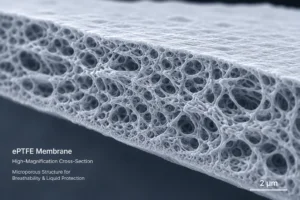
Unlike traditional solid PTFE, ePTFE is processed into a microporous structure containing billions of microscopic pores.
These pores create a unique combination of properties:
- Air permeability
- Waterproof protection
- Chemical resistance
- Pressure equalization capability
The membrane acts as a selective barrier:
| Can Pass Through | Blocked |
|---|---|
| Air | Liquid water |
| Gas | Dust particles |
| Water vapor | Contaminants |
The unique microporous structure is the reason ePTFE membranes are widely used in demanding industrial applications.
How Does an ePTFE Vent Membrane Work?
The working principle is based on controlled gas movement through microscopic pores.
Step 1: Pressure Difference Occurs
Inside a sealed product, pressure may increase or decrease because of:
- Heating and cooling cycles
- Chemical vapor expansion
- Electronic component operation
- Battery charging and discharging
Example:
An outdoor electronic enclosure becomes hot during daytime operation. The internal air expands and creates higher pressure.
Step 2: Gas Moves Through the Membrane
When pressure difference occurs, air molecules move through the ePTFE membrane.
The membrane allows:
- Air exchange
- Gas release
- Pressure balancing
while maintaining protection against external moisture.
Step 3: Water and Contaminants Are Blocked
Although air can pass through, liquid water cannot easily penetrate.
This happens because:
- ePTFE has hydrophobic properties
- The pore structure is extremely small
- Surface tension prevents water entry
The result is a waterproof breathable barrier.
The Science Behind Waterproof Breathability
Microporous Structure
The most important feature of ePTFE is its microporous network.
The structure provides:
Gas Permeability
Allows:
- Oxygen
- Nitrogen
- Water vapor
- Internal gases
to move through the membrane.
Waterproof Protection
The membrane prevents:
- Rainwater
- Liquid chemicals
- Moisture droplets
from entering protected components.
Chemical Stability
PTFE materials are known for excellent resistance to many chemicals and harsh environments.
This makes ePTFE suitable for:
- Chemical containers
- Industrial equipment
- Automotive systems
Why Pressure Equalization Is Important
Many engineers initially believe a sealed enclosure provides maximum protection.
However, complete sealing can create another problem.
Without Venting
Pressure imbalance may cause:
- Housing deformation
- Seal stress
- Leakage risk
- Component damage
With ePTFE Venting
A vent membrane provides:
- Continuous pressure balance
- Reduced mechanical stress
- Improved product reliability
- Longer service life
Pressure equalization is one of the main reasons ePTFE vent technology is used in industrial protection systems.
ePTFE Membrane vs Traditional Waterproof Materials
| Property | ePTFE Membrane | Traditional Waterproof Film |
|---|---|---|
| Waterproof | Excellent | Good |
| Breathability | High | Limited |
| Pressure Equalization | Yes | No |
| Chemical Resistance | Excellent | Depends on material |
| Industrial Durability | High | Medium |
Traditional waterproof materials focus mainly on blocking water.
ePTFE provides both:
Protection + Ventilation
Main Applications of ePTFE Vent Membranes
1. Electronics Enclosures
Electronic devices generate heat during operation.
ePTFE membranes help:
- Release internal pressure
- Reduce condensation
- Protect circuit components
Applications include:
- Sensors
- Control units
- Outdoor electronics
2. Battery Systems
Battery systems require reliable gas management.
ePTFE vent membranes help:
- Balance pressure
- Protect battery housings
- Improve safety
Common applications:
- EV battery packs
- Energy storage systems
- Battery modules
3. Chemical Packaging
Chemical containers may experience pressure changes caused by:
- Temperature variation
- Chemical vapor generation
- Transportation conditions
ePTFE membranes provide controlled venting while reducing leakage risks.
4. Automotive Components
Vehicles experience:
- Heat cycles
- Vibration
- Moisture exposure
ePTFE vent solutions protect:
- Lighting systems
- Electronic modules
- Sensors
How to Select the Right ePTFE Membrane
Engineers should consider:
Airflow Requirement
Different applications require different ventilation rates.
Waterproof Performance
Outdoor applications may require higher water entry pressure protection.
Chemical Compatibility
The membrane must withstand:
- Chemicals
- Oils
- Cleaning agents
- Industrial environments
Temperature Range
Consider:
- Operating temperature
- Storage conditions
- Thermal cycling
Ventrase ePTFE Technology Solutions
Ventrase develops waterproof breathable ePTFE membrane solutions for industrial applications.
The technology supports:
- Protective vent membranes
- Pressure equalization solutions
- Customized vent structures
Applications include:
- Electronics
- Battery systems
- Industrial equipment
- Chemical packaging
Ventrase provides technical resources including membrane specifications, testing information, and engineering guides.
Frequently Asked Questions
What is an ePTFE vent membrane?
An ePTFE vent membrane is a microporous expanded PTFE material that allows gas exchange while preventing liquid penetration.
Why is ePTFE waterproof and breathable?
Its microporous structure allows air and vapor molecules to pass while blocking liquid water.
Where are ePTFE membranes used?
They are commonly used in electronics, batteries, automotive components, chemical packaging, and industrial equipment.
Does ePTFE resist chemicals?
Yes. ePTFE provides excellent chemical stability for many industrial environments.
Conclusion
ePTFE vent membrane technology provides an effective solution for products that require both environmental protection and pressure equalization.
By combining waterproof performance, breathability, and chemical resistance, ePTFE membranes help engineers design safer and more reliable industrial products.
As industries continue to demand higher protection standards, waterproof breathable vent technology will remain an important component in advanced product design.