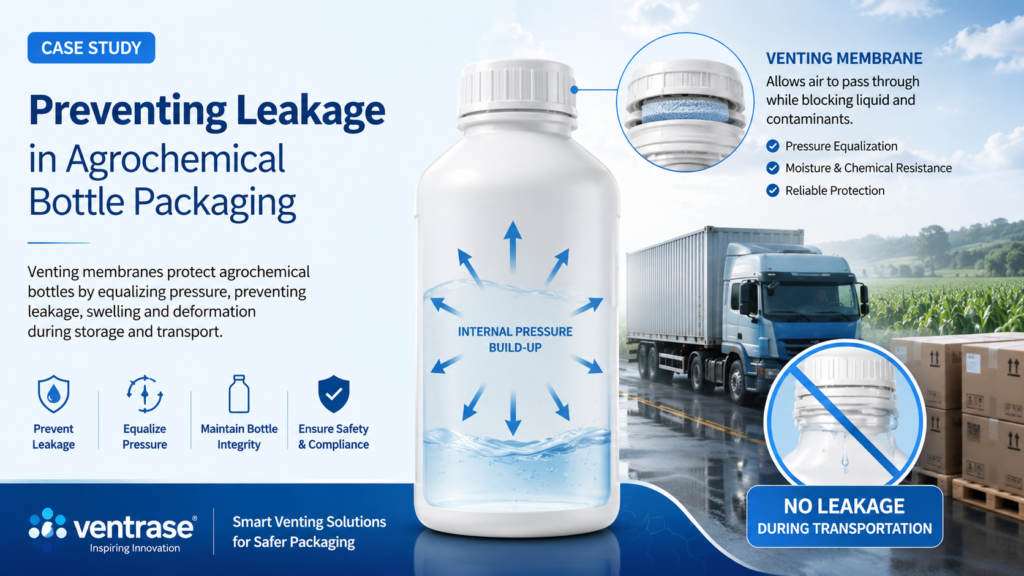
Agrochemical packaging must protect products such as pesticides, herbicides, fungicides, and liquid fertilizers throughout filling, storage, transport, and end use. These liquids are often packed in HDPE bottles, jerry cans, and chemical containers with screw caps, liners, or induction seals.
However, changes in temperature and altitude can create pressure differences inside sealed containers. When pressure builds up, bottles may swell, caps may leak, labels may be damaged, and outer cartons may become contaminated.
ePTFE vent membranes provide a practical solution for pressure-sensitive agrochemical packaging.
Pressure Challenges in Agrochemical Containers
Agrochemical products may be transported through hot warehouses, shipping containers, cold storage areas, and long-distance distribution networks. During these changes, air and vapors inside the container can expand or contract.
A fully sealed closure may trap internal pressure. This can create stress around the bottle neck, cap, liner, and sealing surface.
Common packaging issues include:
- Bottle deformation or swelling
- Leakage around caps and closures
- Pressure release when the container is opened
- Damaged labels and cartons
- Product loss during transport
- Higher cleaning, replacement, and complaint costs
For export packaging, these risks can become more significant because products may remain in storage or transit for extended periods.
How ePTFE Vent Membranes Work
An ePTFE vent membrane contains a microporous structure that allows air and gas to pass through while helping block liquid, water, dust, and contaminants.
When installed in a cap, liner, vent plug, or adhesive vent patch, the membrane creates a controlled airflow path between the inside and outside of the container.
This helps the package gradually equalize pressure without leaving an open hole that could allow chemical leakage.
Learn more about breathable membrane structures and venting technology on Ventrase.net.
Suitable Agrochemical Packaging Applications
ePTFE vent membranes can be used across a wide range of agrochemical packaging formats, including:
- Pesticide bottles
- Herbicide containers
- Fungicide bottles
- Liquid fertilizer packaging
- HDPE chemical jerry cans
- Agricultural adjuvant containers
- Crop protection product bottles
- Chemical drum closures
The correct membrane specification depends on the liquid formulation, container volume, cap design, airflow requirement, storage conditions, and transport route.
Benefits for Pesticide Bottle Packaging
A properly selected vent membrane can improve the overall performance of agrochemical packaging.
Key benefits include:
- Helps equalize internal and external pressure
- Reduces pressure stress on caps and liners
- Supports leak-resistant packaging performance
- Helps reduce bottle swelling and deformation
- Protects cartons from liquid contamination
- Supports safer handling during transport
- Can be integrated into existing closure systems
- Allows customized airflow performance for different products
The membrane should be tested with the actual chemical formulation before full-scale production to confirm compatibility and packaging performance.
Vented Closures for Export Transport
Agrochemical containers may pass through several environments before reaching the final customer. A product may be filled in one climate, stored in another, shipped by sea, and delivered to a market with different temperatures.
A vented closure can help reduce pressure changes caused by these conditions. This supports more stable packaging performance during long-distance transport and warehouse storage.
For applications where leakage protection and controlled airflow are both important, an ePTFE vent membrane can offer a more reliable alternative to an open vent hole.
Custom Agrochemical Venting Solutions
Ventrase develops breathable vent membrane solutions for agrochemical bottles, chemical jerry cans, lubricant containers, industrial liquids, and other pressure-sensitive packaging applications.
Membrane solutions can be customized based on cap size, liner structure, vent location, airflow level, chemical compatibility, and packaging requirements.
For custom samples or technical support, contact Ventrase at info@ventrase.com.