
ePTFE vs PTFE: What Is the Difference Between Expanded and Traditional PTFE?
PTFE and ePTFE are two closely related fluoropolymer materials with excellent chemical resistance, temperature stability, and durability.
Although both materials are based on polytetrafluoroethylene (PTFE), their structures and applications are significantly different.
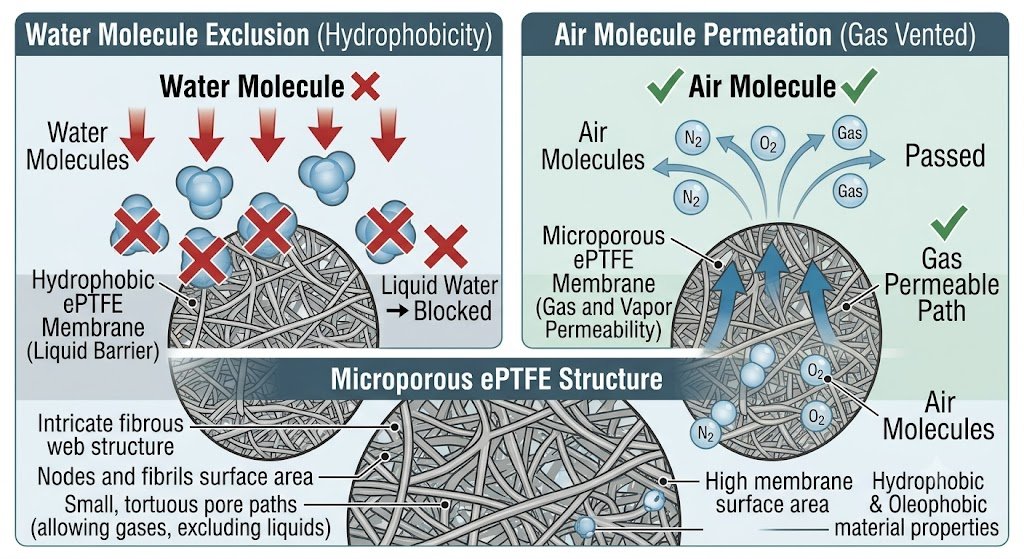
The key difference is that ePTFE (expanded PTFE) has a microporous structure created through a controlled expansion process, giving it unique waterproof breathable properties.
This article explains the differences between PTFE and ePTFE, including structure, performance, and industrial applications.
Learn more about ePTFE membrane fundamentals:
What Is PTFE?
PTFE, also known as polytetrafluoroethylene, is a high-performance fluoropolymer developed for demanding industrial applications.
It is well known for:
- Excellent chemical resistance
- High temperature resistance
- Low friction coefficient
- Non-stick properties
- Electrical insulation performance
Traditional PTFE has a dense structure, which means it does not normally allow significant airflow or gas transmission.
What Is ePTFE?
ePTFE stands for expanded polytetrafluoroethylene.
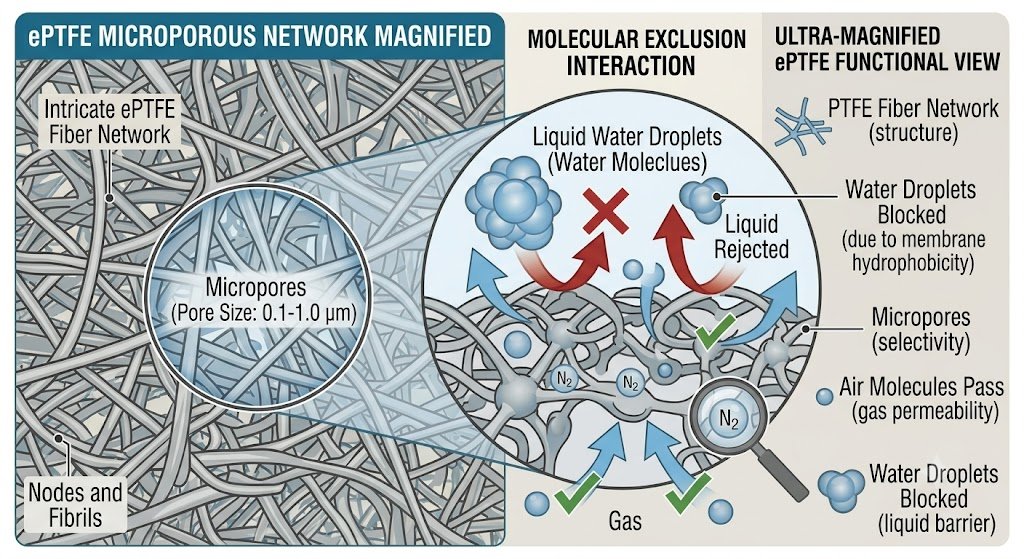
It is produced by stretching PTFE under controlled conditions, creating a three-dimensional microporous structure.
This structure provides additional functions:
- Air permeability
- Waterproof protection
- Gas transmission
- Pressure equalization capability
How Is ePTFE Different From PTFE?
The main difference between PTFE and ePTFE is the internal structure.
| Feature | PTFE | ePTFE |
|---|---|---|
| Material | Polytetrafluoroethylene | Expanded Polytetrafluoroethylene |
| Structure | Dense structure | Microporous structure |
| Air Permeability | Very limited | Excellent |
| Water Resistance | Excellent | Excellent |
| Gas Exchange | Limited | High |
| Typical Application | Sealing, coatings, industrial parts | Membranes, vents, filtration |
Why Does ePTFE Have Waterproof Breathable Performance?
The unique performance of ePTFE comes from its microporous structure.
The pores are:
- Small enough to block liquid water
- Large enough to allow air and vapor molecules to pass
This allows ePTFE membranes to achieve both:
- Waterproof protection
- Breathable ventilation
Related technology:
What Is a Waterproof Breathable Membrane?
ePTFE vs PTFE: Performance Comparison
| Performance | PTFE | ePTFE |
|---|---|---|
| Chemical Resistance | Excellent | Excellent |
| Temperature Resistance | Excellent | Excellent |
| Breathability | Low | High |
| Pressure Equalization | Limited | Excellent |
| Vent Applications | Limited | Widely Used |
Why Is ePTFE Used for Vent Membranes?
Vent membranes require a material that can protect against liquids while allowing gases to move through.
ePTFE is ideal because it provides:
- Waterproof protection
- Airflow control
- Chemical resistance
- Long-term durability
These properties make ePTFE widely used in:
- Pressure equalization vents
- Battery enclosure vents
- Electronic protection vents
- Chemical packaging vents
Industrial application examples:
Applications of PTFE and ePTFE
PTFE Applications
- Sealing components
- Industrial coatings
- Bearings
- Chemical-resistant parts
ePTFE Applications
- Waterproof breathable membranes
- Protective vent membranes
- Filtration systems
- Medical applications
- Battery and electronics protection
How Is ePTFE Manufactured?
ePTFE is created through a controlled stretching process that changes PTFE from a dense structure into a porous membrane.
The manufacturing process controls:
- Fiber structure
- Pore size
- Airflow performance
- Water resistance
Learn more:
Choosing Between PTFE and ePTFE
| Requirement | Recommended Material |
|---|---|
| Chemical resistance only | PTFE |
| Waterproof breathable function | ePTFE |
| Pressure equalization | ePTFE |
| Protective vent applications | ePTFE |
Conclusion
PTFE and ePTFE share the same chemical foundation, but their structures create very different performance characteristics.
Traditional PTFE is ideal for sealing and chemical-resistant applications, while ePTFE provides additional breathable waterproof performance through its microporous structure.
For protective vent membranes, pressure equalization systems, and waterproof breathable applications, ePTFE has become the preferred material technology.